Flipping the servant worship switch

[My point here is probably better made in the children’s message at the bottom of this post. I understand if you’d rather skip ahead to it.]

I have a confession to make: I have been a moody worshipper, grumbling and getting upset if two songs in a row left me cold. We’ve been at our new church for about a year, but even this winter, I could be in tears about music selection — and my husband was one of the people picking and leading music. I sometimes desperately missed the music at our previous church and that got in the way of my appreciation of other parts of the service. The music at the new church was (and is) good, and I love singing old hymns again, but I was wrapped up in my own sense of what “proper” worship was.

Something needed to change and, conveniently, and predictably, I didn’t think it was me.

And then this past spring I interviewed over a dozen ministers in order to write profiles on their churches (for this project). I asked each one the same five questions, one of which was, “What are your strengths as a congregation?” One of the answers changed my experience of worship — changed it utterly.

Bob Boersma of Providence Christian Reformed Church said that servant worship was one of their strengths. He characterized servant worship like this: “We ask our people to sing along [with songs they may not like] because someone else may need to sing it.” So the act of worship is not just personal, and it isn’t just communal — that is, we’re not each doing our own personal worship all in the same place. Worship as an act of service to the other people in the congregation is more intimate. It requires me to give up (some of) my fussiness about worship, to modify my need to get something out of every moment of the service and my right to be upset if every moment of the service doesn’t speak to me.

I found this glorious. And freeing. But also grounding. Even better, it helped connect me to the church that still felt foreign to me after seven months of involved membership.

It’s not like the servant worship switch being flipped made everything about worship wonderful. It didn’t. There are still songs I don’t like, songs that don’t feel particularly worshipful to me. But now I think to myself, “here’s a servant worship moment,” and I sing with my eyes open (otherwise, I close my eyes), looking around for those people who are getting their worship on, looking for the people singing with their eyes closed, or raising their hands, or bouncing their clapping baby. I listen for the voices of the older women singing their hearts out or the “Amen” from someone in the back. And in those moments, I can be glad that we’re singing that song I don’t like.

This explanation has been pretty good, but I think I said it best yesterday in my children’s message:

I’ve been thinking about children’s worship starting up again soon, and thinking about the songs we sing. Songs like the walls of Jericho song [to the adults, I noted that it was one of our crazier songs]. Some of you love, love, love it. And some of you are kind of scared by the craziness of it. And I was thinking about my 3 versions of Jesus Loves Me. Some of you love the sweet and quiet regular version and some kids love the louder rock and roll version. That happens in grown-up church, too.

I have a confession to make. Can we keep it just between us? That song we did two songs ago, [name of song], I don’t like it very much. I don’t.

But I sang it anyway.

Why do we sing songs that some people don’t like?

Let’s do an experiment. Grownups and kids, I’ll need your help on this. If you loved that song, if it made you joyful, it you felt the love of God for you or your love for God while you sang, raise your hand.

[a couple dozen hands went up]

Look at that. Look at all those hands of people who loved that song, who were really worshipping while they sang it.

So that’s why. But it’s only part of why we sing songs not everyone loves. Here’s the bigger reason.

[did the sign language for love and made the kids tell me what it meant]

That’s right. Love. We are all God’s family here, and because God loves us, we love each other and we want to serve each other. Jesus served the people he loved. Even though he was God, he washed his friends’ dirty, smelly, sweaty, disgusting feet. Serving someone by singing a song I don’t like is a lot more fun than washing their smelly feet.

So that’s why we sing a lot of different songs in children’s worship and in grown-up church: we’re a lot of different kinds of people who love a lot of different kinds of songs who feel and express the love of God in all kids of different ways — and because we love each other, we serve each other by sometimes singing things we don’t personally like. It’s servant worship, and it’s a lot more fun than washing smelly feet.

Let me note here that I am not suggesting that you stay in a church even when God is nudging you out just so you can be of service to the people there by participating in worship you can’t stand. And I’m not saying that all churches need to sing a variety of music — I’ve never met anyone whose spirit soared during every single song that was sung in their church.

I am suggesting that changing how you think about worship — in particular, changing how you think about singing songs you don’t like — can help you feel more connected to your fellow congregants, can give you joy even in the midst of songs you don’t like, can utterly change your experience of worship for the better. It did for me.

And now, because I’m talking about worship, you may commence yelling at me.


Magical Thinking Makes Me An Island

I am a hypocrite.

Lately, I’ve been writing about fear and about moving ahead despite fear. I’ve talked with one of my kids multiple times over the school year about magical thinking: as in, “you can’t just let your unfinished work pile up, hoping that it will go away and everything will resolve on its own.” I can honestly say that I’ve been doing things this year that give me high anxiety and the change and growth that have resulted have been really, really good.

Except in one case.

My daughter had 4 E.R. visits in from December to May, one of which involved an overnight stay, two of which involved IVs and X-rays, and one of which involved a broken bone. An avalanche of insurance paperwork and hospital bills have been arriving at our house. And I let them pile up.

After awhile, I let them pile up unopened.

My husband’s company had switched insurance companies two weeks before all this started, and the new company’s policies were incomprehensible to me. When my husband called about the first item that arrived, he was told to wait, that they’d pay that soon.

I took that too much to heart. Way too much.

In May, I made a binder for all the medical stuff, and I paid a few things from our flex pay account. I even discovered that we could pay bills based on the full amount that we’d set aside for the flex pay, that we didn’t have to only use what was in there at the time. Even so, I let the bills pile up. Unopened. As if everything would be fine. I’d been praying about it for months, praying that I would push through my anxiety and take a look at the bills, asking God to help me stop being such an idiot. I couldn’t sleep. For weeks, every time I woke up in the middle of the night, I’d lay there in a stew of anxiety and fear. And in the morning, I’d do nothing.

So this past Wednesday, I taped two pieces of paper together, opened the binder, opened every piece of mail, detailed everything in one big chart, tossed duplicate bills. And discovered that we had enough in the flex account to pay for everything. I felt chastened and relieved. And really, really stupid for having wasted so much time.

At least part of the relief was that I didn’t have to feel so alone anymore. Because that’s part of magical thinking: it keeps you alone. Alone and terrified. You can’t admit your magical thinking because as soon as you say it out loud to another person you realize how irrational it is and then your adult self will have to step in and do something about it — if you don’t, the person you said it to will step in. This is a lonely place to be.

I’ll have to confess this to the child I talked to about magical thinking, which should be good for both of us. And make us feel less alone.

Anyone have any magical thinking they want to confess? Feel free. You already know I’ll relate to it.

This was part of my participation in Lisa-Jo Baker’s Five Minute Fridays, wherein we write for 5 minutes about a common topic. This week’s word: lonely.

What a great concert does to a person

The last time I went to a concert in a basement was 17 years ago in a grim bar on the eastern edge of the East Village, when my husband’s band, The Haints, went on at 2 a.m. to play to the 3 friends and 2 near-comatose strangers in attendance, all of us drinking $8 glasses of soured McSorleys. I think we all hated each other by the end.

This was the opposite of that show in every way.

Jason, Toby Hazlet and Gerko Tempelman

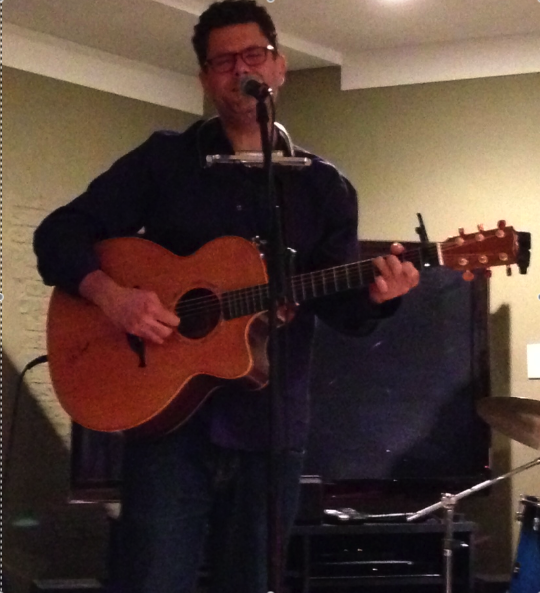
Friday, July 19, Jason Harrod and his traveling band – Toby Hazlet on the ukulele bass and providing nicely understated harmonies, and Gerko Tempelman on drums – played a garden concert in Chris Smit and Lisa Van Arragon’s basement. Rain earlier in the day left everything outside wet, so they moved it downstairs. A great decision. There were no distractions from the music in that limited space, so emotion could build and flow between and among us. I felt it as an audience member, and I hope we were feeding it back to Jason and the band.

He had an opening act, local 16-year-old singer-songwriter, Maddy Wiering. In the interests of full disclosure, I should say that I’ve known Maddy since she was 4 – the flutey little voice she had back in the days of minivan carpools has matured into a high and lonesome sound that draws in and holds on to the listener. Okay, more full disclosure: I asked my husband, a musician, how he’d describe Maddy’s voice, and “high and lonesome” was his answer.

Many of her songs are restrained in presentation, so you can really hear the lyrics, and appreciate the pathos of “Tough All Over,” which is about not being tough all over. But then she can strum her guitar harder and sing louder and wilder so we can join her in the crazier side of human relationships in “Crazy.” It was really fun to watch other musicians in the crowd nod along as she played, to hear them laugh to themselves when she got something so right. Check her out on SoundCloud. A fitting opener for Jason.

I love Jason’s voice. There, I’ve said it. It does something to the back of my neck, in particular, not quite shivers, not goosebumps, but that’s where I feel it. For the entire time he’s singing. Especially when he breaks out the falsetto. I just had to get that out.

Indulge me one more time. Jason stood in front of us with more command, more generosity, more comfort than I remember seeing from him in the past. He guided us on emotional journeys and we were happy to be led. I blame/credit his recent experience as a worship leader. I’ve seen this same change in another long-time performer; not quite enough of a sample to make for a full-blown theory, but close.

Now on to the show.

Even before he started singing, the mood in that basement was rather gleeful – we were all so happy to be there, even the chubby baby with squeezable legs sitting on his dad’s lap. Jason started with an oldie, “Siren Song,” which got our heads and toes bopping. In the intro to the next number about riding the subway, he confessed that his songs are generally about God, women, or geography, or a combo of all three. He was right; there was only one song that didn’t fit that description.

The third song was the first new one he played, a cool mix of monumental and granular imagery. “When I came down off the mountain, I was breaking like a wave,” to lyrics about particles of dust. And then in the middle of this fantasy, he pierces us: “Who’s going to love me today? Who’s going to calm me down? Who’s going to take me as I am? Who’s going to take me home?” This was the first of three times Rachel Laughlin leaned over another person to look at me long and hard before finally whispering, “I love that one.”

Then it was on to “Moon Mission,” the first single off the new album Highliner (give it a listen here). What seems, at first, like a straightforward song about the last man to walk on the moon turns into an exploration of the sadder and bleaker side of human experience: “I’ll be your sweet sailor up in the sky … There’s nothing for me down here.” This is something Jason does so well. At the end, Steve de Ruiter called out, “That’s a killer tune, man.”

I must add that opening act Maddy Wiering pulled a similar shift in her song, “The Girl With The Gorilla Tattoo.” It started out as a cheerful story song about a waitress in Nashville with some impressive tattoos, but then Maddy took it somewhere else with the observations that nobody knew her name or cared to hear her stories. Bodes well for her future songwriting.

By the end of Jason’s next song, we weren’t just appreciating a good line or a gorgeous falsetto or an intricate guitar solo (a more music-y person would’ve written more about that, because he’s got some chops, but I’m a word person, so that’s what I tend to focus on). The room hushed when he took out the harmonica for “The Messed-up Everywhere Blues.” The next phrase looks sort of wrong in print, but it’s the best way I can think of to describe us during the next song: we were feelin’ each other, and feelin’ him. The plaintive cry at the end, with his “Jesus don’t take my song away,” and the repeated, “you know I only play for you,” just got me.

When he sang “Carolina,” it was the first of a few times that I could hear people singing along – it’s hard not to for longtime fans. But they didn’t sing along very loudly. I call it “ghost harmony.” Just loud enough to hear it, but not loud enough that you get annoyed because you didn’t come to hear people in the audience sing (or is that just me who gets annoyed when the person in front of me sings louder than the person I came to hear?).

Jason introduced the next song as a straight-up prayer: “Chains” — “Take these chains from off my neck …Melt them down into something good.” One wouldn’t normally characterize a prayer this way, but in my notes, I wrote, “this is the shit.” In all caps. Also, “If my husband doesn’t do this song at church sometime, I’ll leave him.” Beth Skillen and I almost raised our hands as if we were in church.

I was still recovering from “Chains,” so I didn’t recognize one of my favorite Jason Harrod tunes until he started singing “My Mad Girlfriend.” I sat in a row with two other women above 35, each with somewhat passionate, emotionally intense natures, and it was a blast listening to this song together. Did I give a whoop at the line, “She’s so boss”? Yes. Yes, I did.

And that was just the first set, people.

I won’t exhaustively detail the second set (for fear of losing everyone), but it was just as wonderful. After “Kicking Mule,” it was a little more contemplative in tone than the first set, and marvelously intimate. All the lights were on in the basement, so Jason could see us clearly and we could see each other, appreciate each other’s reactions to each song, hear each called-out encouragement (enjoy Steve de Ruiter’s multicolored striped socks). Toby and Gerko added great energy to the songs and to the evening. We even found a few people to speak Dutch with Gerko and his wife Rachelle.

Big thanks to Chris and Lisa (and Moses) for hosting and to the musicians for giving us an experience. It was a great night. If you’re reading this and you haven’t seen Jason and Toby and Gerko yet: make plans to do so. Go here to see the rest of the tour schedule (many East Coast dates in August). And if you feel inspired to host them for a house concert: go for it. It was the kind of night where we all loved each other a little more by the end. I’m still smiling about it.

sometimes I want to break up with the Bible

So I’ve been participating in these Five Minute Friday posts (prompted by Lisa-Jo Baker), and today’s word is broken. I want to keep up with this habit, this community, but I also have something else that’s been bugging me, so bear with me as I go a bit past 5 minutes.

Sometimes I want to break up with the Bible.

I come to the Bible a broken person. I have a sinful, selfish mind that can grab onto technicalities and blow little things out of proportion. More than that, I’m a specifically broken person, with my own experiences and my own hang-ups (as a result of those experiences), my own expectations. Even more than that, I’m a hurt person, a hurting person. I bring those hurts and (sometimes secret) fears to my reading.

This is partially why I’m reading the Bible through from beginning to end: no more picking only my favorite parts, no more focusing only on the fun passages, the passages that support what I already think and believe. This has meant dragging myself through Numbers (why, oh why repeat each set of numbers twice?!?), but also meant discovering gems of passages I wouldn’t have found otherwise.

Right now I’m reading Ezekiel. That is one weird book of the Bible. God really puts some of his prophets through the ringer. It starts with a fantastical vision of strange beings with wings and wheels and multiple faces and God giving Ezekiel a scroll of funeral dirges and pronouncements of dooms and making him eat it. Actually chew and swallow it (don’t worry, it tasted as sweet as honey). But within the weirdness is this:

“You must give them my messages whether they listen or not….And whether they listen or not — for remember, they are rebels — at least they will know they have had a prophet among them” (Ez. 2:7, 5, NLT).

I am not a prophet and I have no plans to ever go around calling myself Prophet Natalie. But God puts things on my heart to say, to write. And that passage tells me to say and to write them whether people respond or not, because my responsibility is to give the message that God has given/does give/is giving me, to use the voice God has given me. It’s not my job to fuss about how many readers I have or to despair because people don’t seem to be listening. It’s my job to speak. I am encouraged by this. It sets me free.

Ezekiel has to pull some crazy stunts (although God goes back on his request that Ezekiel defile his food by cooking it over human dung patties). I tend to approach these as God doing the equivalent of making a viral video: he’s having his prophet pull a public stunt that people will see and just have to talk about with people at the market, at the threshing field, on the roads (see Ez. 5 & 12).

“Did you hear what Ezekiel did this time?”

“Can’t be crazier than when he shaved his head and beard and divided it into thirds and burned part, scattered part, and slashed part.”

“Why did he do that again?”

“To show what will happen to Jerusalem because we’re ‘so rebellious.’ What was it now?”

“He packed his stuff, dug a hole in the wall, and walked away with his hands over his face. Says we’ll all be in exile, never to return, even Zedekiah.”

God will use anything to get his people to listen, even our love of gossiping about something crazy that someone did. I can appreciate that.

But then Ezekiel 16 has a disturbing metaphor about Israel as an abandoned female baby that God cleaned and cared for and raised and then married, but the wife/Israel trusted in her fame and beauty and gave herself as a prostitute to every man/country that came along. The wife/Israel used the gifts God gave her and turned them into idols and gifts for idols and gifts to all her lovers. The story gets quite graphic about how God will turn over the unfaithful wife/Israel to her lovers for them to destroy.

Israel as an unfaithful wife is a common metaphor in the prophets, and I’m trying to take to heart the message that my relationship with God is an intimate one, that God feels my betrayals as personally as a spouse who’s been cheated on. As a result, I’ve been trying not to skimp on the confession part of my prayers in my rush to get to the assurance of pardon. I can also approach the story as historical, as describing the history of Israel and saying how it will be for Israel in exile.

Still, this story sits in my gut like a gas bubble and I’m not sure what kind of foulness will result it it bursts.

And then I read on. Ezekiel 23 is about the repeated adultery of two sisters (aka Samaria and Jerusalem) against their husband/God. The story starts with this indictment: “They became prostitutes in Egypt. Even as young girls, they allowed themselves to be fondled and caressed” (v. 3). As if a young girl makes that happen because of her lust. As if a young girl being fondled is her fault.

There’s more stuff in the chapter, but that’s what really got me, what sent a lick of flame to one of my fears: that the Bible is a book by men for men, where what I am (female) is repeatedly misunderstood and misrepresented and used as a metaphor for what is wrong.

I know, I know. There’s more than that to God and more than that to the Bible. But it’s easier to keep that assurance going when I don’t have to read stories like the above. It is, in fact, what kept me from a regular devotional practice for years: fear that I’d meet a God who challenged my beliefs about him. But stories like that are in there. And I have to deal with them.

Here’s how I do it. I will keep reading the Bible, and I will find something amazing, something that gives me hope, something that tells me how much God loves me, how radical and countercultural God is, and the bubble will deflate. The bubble will still be there, because the Bible has some disturbing stuff in it that’s hard for this woman to deal with. But I also know that God is bigger than any culture’s language or stable of metaphors about him.

So even though I kind of want to at this moment, I won’t break up with the Bible. And I definitely won’t break up with God. I’m going to be uncomfortable for a little while, no doubt about it. But God will love me through it. He always has, and he always will. That is my faith.


belonging is a decision

Here’s a thing about belonging: being chosen isn’t enough.

Let’s say you want to be part of a group. You can see them over there being awesome in exactly the way you’d like to be awesome. If only they chose you. Well, let’s say they choose you. Does that solve everything? For some people. Those people will bounce into the group, happy to be there. Others will question themselves: Do I really belong here? Are they just being nice? When will they notice that I’m not worthy to be with them?

Belonging is a feeling, but it is also a decision, a choice you make.

It’s a decision to accept being chosen. Yes, I do belong here. I am worth belonging here. Or even, I’m not on a level of experience with these people, but I will be; this is where I want to be. But especially, they are just people, scared and scarred and sometimes insecure, like me. Because if it’s a good group, a group that lifts up its members by both encouraging and challenging them, that’s one thing I guarantee you’ll find out about each other: you are all striving.

It’s a decision to reject being chosen. No, the cost for belonging here is too high — you’re too snobby, you reject too many people, you take drugs, you take steroids, your sense of humor is too mean. A great deal of personal growth occurs for the “no, I do not belong with you people, I do not want to be the kind of person you have to be to belong in this group,” to happen.

It’s a moment in every Disney show, whether cartoon or live action, when an “outsider” somehow gets in with the “in crowd” and has to be mean in some way to their best friend; then the resulting angst and the pointed words of said best friend teaches them that there are more important things in life than being in the in crowd. (This was the first example that popped into my mind because this is the first summer I’m letting my 12-y-o daughter watch live action Disney shows, so she’s rather bingeing on them.)

This is when your question changes from “do I belong to you/with you?” and “do I measure up?” to “do you belong with me?” and “do you measure up to me?”

There are probably all kinds of groups you’ve been in that you’ve unchosen after awhile, or people you’ve culled from your life because they don’t belong in the kind of life you want to build for yourself and your loved ones. So own that when you feel that being chosen isn’t enough.

*** There might be more wise words, but my five minutes are up in my Five Minute Friday exercise, hosted by Lisa-Jo Baker. ***

Resistance is not a sign of Failure

I’m going to be a great artist here (as in Picasso’s, “Good artists copy, great artists steal). I’m going to steal from Steven Pressfield:

“Resistance is the shadow cast by [the Dream].

Resistance is the equal-and-opposite-reaction of nature to the New Thing that you and I are called to bring forth out of nothing.

There would be no Resistance without the Dream. The Dream comes first. Resistance follows.”


In particular, “Resistance is the shadow cast by the Dream.”

In Jungian theory (which I’m mostly familiar with through the novels of Robertson Davies), we all have a shadow-side; it’s part of being human. My shadow is all those aspects of my personality that I prefer not to consciously acknowledge, either because they’re negative, or they frighten me, or they conflict with ideas I have about how I should be. For Jung, your shadow can be negative and/or positive, all mixed-up. The goal is not to push down or deny the shadow, but to acknowledge it, and even to assimilate it. This means facing the negative aspects of yourself, and accepting that you have negative aspects, without allowing them to take over. You embrace all sides of yourself, thereby giving the negative less power to overtake you, and enabling you to better relate to the people around you (because you’re not denying or threatened by their shadows, either).

So having a shadow isn’t bad. It doesn’t mean you’re bad. It doesn’t mean you’ve failed. It means you’re human.

Resistance as the shadow of the Dream is revolutionary to me. On his Writing Wednesdays, Pressfield often writes about Resistance (that something inside us that will fight us when we pursue our creative dreams, taking the form of fear, insecurity, distraction, perfectionism, despair, whatever it takes to block us), and I’ve certainly felt it and succumbed to it and fought it.

That should be in present tense: I feel it, I succumb to it, I fight it.

Even though Pressfield and other writers about creativity, such as Julia Cameron (author of The Artist’s Way), write about the omnipresence of Resistance, in a little corner of my mind, I thought that Resistance meant that I was a failure as a writer. That if I was only a better writer or had more of a professional attitude or a deeper vision for my work or more discipline or more creative freedom or a higher self-image, I wouldn’t be so plagued by Resistance at times.

But if Resistance is the Jungian-style shadow of the Dream, I cannot be rid of it and I shouldn’t want to be rid of it. It is part of having a Dream, of pursuing a vision. Instead of seeing the shadow as a sign of my failure, I can investigate the shadow, converse with it, see whether it has anything of value to tell me about myself or my Dream.

Even if I think of the Dream-shadow as being like a physical shadow, then it’s always there — except maybe during those high noon moments of the Dream, when I’m flush with inspiration and fully in the flow. Otherwise, as long as there’s sun (i.e. the Dream), I will cast a shadow.

Maybe acknowledging this will give Resistance less power over me. Over you, too.

Resistance doesn’t mean we’ve failed. It means that we have a Dream and that we’re pursuing it.

That makes me grin. And look forward to greeting my shadow with a, “Good morning. Nice to see you. I’m going to work now.”

How are you beating Resistance? Or succumbing to it?


3 ways to be more present

1. Be bad at technology.

This will make it easier for you to not be constantly looking down at your phone. Being with people yet constantly checking your phone means that you are not present to/with those people in front of you (people who are often your children). Maybe you don’t like those people you’re with and you only like your phone/internet people, but that’s a bigger and different problem. If you are good at technology, it will be far more difficult for you to put your phone away without anxiety.

2. Look around.

This is an interesting world. Even the insides of some seed pods have beautiful designs. Look at stuff. Pick it up. Investigate it. Watch people. Make up stories about them. Just plain enjoy where you are. Right now. Like now, all the trees in my backyard are in shadow except for the Rose of Sharon bush/tree, which is lit up bright, bright green. That was worth a smile.

3. Ask questions.

When you’re with people, ask them questions. And when they’ve answered a question, ask a follow-up. It’s amazing how many people don’t do this, how many people parallel-monologue, like toddlers parallel-playing. You’re a grown up; don’t be a conversational toddler. Asking questions takes you out of your head and makes you present in that moment with that person/those people — and then they feel valued. Oh yeah, and you find out interesting things, too.

So be bad at technology (or work to calm the anxiety of not being constantly connected).
Look around. Ask questions. Be present.

      “We write for five minutes flat. All on the same prompt that Lisa-Jo Baker posts here at 1 minute past midnight EST ever Friday. And we connect on Twitter with the hashtag #FiveMinuteFriday.”


and yet…

Yet. Such a tiny word that can do such heavy lifting.

The power of “yet” to change our minds — to literally change our brains as well as our attitudes and, thereby, our chances for success — is part of this TEDx talk by Eduardo Briceno on The Power of Belief — Mindset and Success. He posits that the key to achieving our goals is not our level of effort or focus or resilience, it’s the mindset that fuels those things.

Fixed Mindset

Those operating under a fixed mindset believe that their intelligence and their abilities are fixed. They are naturally good at some things and not at others, and that will not change. For these people, having to work hard at something is a sign that they do not have the ability to master it. Working hard is itself a sign of failure.

Let me say that again. Failure itself isn’t even required to make them give up. Working hard is itself a sign of failure.

  1. This is really hard.
  2. I’m just not good at those kinds of things.
  3. If I keep going, everyone will see how bad I am at it.
  4. I should move on to something I’m good at.
Such people are most focused on how they’re being judged. Do they measure up to the standard (whatever that is)?

Growth Mindset

People operating under a growth mindset believe that they can change their abilities and their intelligence through their effort. For them, failure is part of growth, so when things get difficult, instead of losing confidence and giving up, they push ahead and figure their way through whatever made them struggle. These people are most focused on learning, on how to improve.

Brain Evidence

Briceno goes on to argue that brain imaging tells us that the growth mindset is the scientifically correct one, that we can develop our abilities and change our brains in the process. We can even change from the self-defeating fixed mindset to the more hopeful growth mindset, in which effort is not a sign of failure but an energizing force.

I am certainly energized by his talk. I definitely had a fixed mindset about a lot of things for a long time. But even before I heard Briceno’s talk, I’d been noticing a shift: my publishing journey was changing my mindset. I had to learn all the time, not only figuring out how to write/rewrite/rewrite a good story, but also how to go out into the world with that story, not to mention how to deal with near 100% rejection. And to still keep going. Work on the story some more. Keep trying. Keep failing. Keep trying.

My social abilities have also changed in the last 10 years. I’m still an introvert, still shy, but I can talk to people more easily now. I have some strategies and go-to questions, some things I remind myself — like that social situations that have terrified me in the past have either been okay or sometimes even wonderful, and in any case, I survived.

The biggest change is that I no longer see fear as a good enough reason to hold myself back. You won’t see me on a roller coaster any time soon (fear still isn’t fun for me), but more and more, my vision trumps my fear. Also, since I’m a religious lady, I step out in trust that God will be with me. I’m getting a lot better at that as I get older, and as I step out in trust more and more. Publishing is a crazy world with so much change, so much to learn, so many new skills to master, some of which I’m naturally good at and some of which take a lot of work — including working at the conviction that early and even repeated failure doesn’t necessarily mean it’s not meant to be. I’m developing more of a growth mindset. Letting my curiosity drive. Giving my imagination the helm. Redefining what success might mean.

But I’m not all the way there. Yet.

Which brings me back to Briceno. To help us move from a fixed to a growth mindset, one of the things he suggests is to include one little word in our sentences to ourselves about our abilities. When we say, “I can’t do that,” add one word.

Yet.

“I can’t do that … yet.”

Yet. Such a tiny word. But I can feel the hope in it, even if it’s just a kernel.

A good friend who lived with “mets” (aka metastatic cancer) for many years, used to say, “I have cancer, but I am not dying today, so what shall I do instead?” And go on to some fun activity, spreading life because she was not yet on her deathbed.

Although it wasn’t at all a part of the TEDx talk, I also see yet such a profoundly Christian word.

This week I’m reading Lamentations, and I came across this (2:11, 3:21-23):

“I have cried until the tears no longer come. My heart is broken, my spirit poured out … Yet I still dare to hope when I remember this: The unfailing love of the Lord never ends! … Great is his faithfulness; his mercies begin afresh each day.”

I have been there. In some areas of life, I’m there right now. Exhausted from despair, but because of God’s love and faithfulness and promises, there is a kernel of hope. I might say the yet with gritted teeth, not seeing how on earth things will change. But I will hang on to it. Because that yet means that I’m looking for and open to God’s leading. Because that yet implies that it is possible — possible for me to be published, for my marriage to get stronger, for my quickness to despair and anger to get slower.

Is there something that seems impossibly hard to you? Try adding “yet” to the negative self-talk you give yourself. It’s just one little word.


Beautiful Isn’t Doing Us Any Favors

There was a post this week on Brain Pickings about how looking at beautiful women can make both men and women judge the attractiveness of non-gorgeous women more harshly. About how focusing on beautiful women, in essence, makes us all unhappier. (Beautiful men did not have that effect.)

Which made me wonder, in general, whether the focus on beauty in general does us no favors. Yes, beautiful things / people / landscapes / moments draw our attention. And, yes, they are a wonder.

But they are the peaks of existence. The freaks of nature. The fleeting moments of perfection.

Which throws everything else into contrast. Most of life is not a peak. It’s not remotely perfect.

So part of my wondering about “beautiful” is how always looking around for and exclaiming about the peaks / freaks / fleeting perfections makes it difficult to settle into all those other 99% of moments of life.

“Beautiful” also irritates me: it holds an exterior standard of attractiveness above all other valuations (like interesting, deep, healed, useful, touching, strong, tender). And the dominant culture is the one that gets to determine what’s beautiful, which is so limiting. And it’s addictive, as in, focusing on beauty over time requires even more intensely beautiful things / people / landscapes / moments to even register as beautiful.

Beautiful seems like it goes deeper than pretty, but is it merely “more intense prettiness”?

I love the beauty in a sunset, a smile, a child’s profile, a piece of furniture. But I’m left with a suspicion about beautiful — it’s nice, but I don’t think it helps us flourish, or helps us invest in the things that should be invested in, or helps us love people any better. So, for me, beautiful gets a shrug. It’s very nice. But so what?

* This is my participation in Lisa-Jo Baker’s Five Minute Fridays.

** I know I’m not supposed to add anything after the 5 minutes, but I’ve been reading a bunch of other FMF posts, and that crystallized what I’m talking about here. I don’t want to redeem “beautiful” from the world, I don’t want to expand the definition to include imperfections. I mistrust it as an adjective. I want to use better words for how a thing/person/landscape/moment makes me feel.

What Is And Is Not A Tool

Does this happen to you? You’re going along, just living your life, and then, BLAM, a cluster of seemingly unrelated things come to your attention that each address something you really need to hear. I call that God, others might call it the universe, or synchronicity, or coincidence. Whatever you call it, it just happened to me in less than 24 hours.

1. The Artist’s Way by Julia Campbell: Week 6, Recovering a Sense of Abundance

“All too often, we become blocked and blame it on our lack of money. This is never an authentic block. The actual block is our feeling of constriction, our sense of powerlessness. Art requires us to empower ourselves with choice.”

2. Seth Godin’s blog: Thinking About Money

“If money is an emotional issue for you, you’ve just put your finger on a big part of the problem. No one who is good at building houses has an emotional problem with hammers. Place your emotional problems where they belong, and focus on seeing money as a tool.”

3. Brain Pickings: How to Worry Less About Money, about a book by John Armstrong:

“The crucial developmental step in the economic lives of individuals and societies is their ability to cross from the pursuit of middle-order goods to higher-order goods. Sometimes we need to lessen our attachment to the middle needs like status and glamor in order to concentrate on higher things. This doesn’t take more money; it takes more independence of mind.”

4. Brain Pickings again, an article about Milton Glaser (graphic artist):

“Do you perceive you live your life through love or fear? They are very different manifestations. My favorite quote is by the English novelist Iris Murdoch. She said, ‘Love is the very difficult understanding that something other than yourself is real.’ I like the idea that all that love is, is acknowledging another’s reality.

Acknowledging that the world exists, and that you are not the only participant in it, is a profound step. The impulse towards narcissism or self-interest is so profound, particularly when you have a worry of injury or fear. It’s very hard to move beyond the idea that there is not enough to go around, to move beyond that sense of “I better get mine before anybody else takes it away from me.”

5. Writer Unboxed post by Jeanne Kisacky: What Not to Think About When You’re Writing, in particular the advice not to “indulge in endless fantasies” about how a piece of writing is going to change your way of life:

“A good story is like a dream brought into momentary focus. It is ephemeral, fleeting, perhaps even surreal, but whole and perfect unto itself. During its crystallization (the process of writing) prosaic thoughts that take the writer outside of that coherent whole turn the writing from a story into a tool. This makes the work simply a step towards something mundane (a better life for the author) not an otherworldly destination of its own (a shining jewel of believable characters, delightful interactions, and gripping tensions).”

6. Sermon on how we often come to God with a list of things we’d like him to make happen for us, and, in return, we will praise him, thereby making God a tool for making our dreams come true.

Some themes I pull out of these quotes:

  • making the wrong things into tools
  • making tools into things to get emotionally twisted about
  • living out of fear rather than love

The idea from the sermon that stuck with me was, “A tool is at its best when it’s being used for what it was designed for”;  God is not the tool, I am the tool, designed for love and worship and service. A story is not a tool to make my fabulous life happen; I am the tool for bringing a transportive story into the world.

Money is not a tool for happiness, but it is a tool for food, clothes, housing, transportation, entertainment, doing good (aka, giving), but also for facilitating creative expression, even mine; I need to stop feeling guilty when I spend money on my creative expression and stop finding excuses not to spend on my creative expression.

Twitter and blogs are tools for exploration and connection. Are they also marketing/networking tools that will be important to my writing career? Yes. But I need to stop getting myself emotionally twisted up and discouraged because they are netting me limited marketing/networking opportunities (not to mention the puniness of my numbers) now. I need to stop projecting the scarcity of now into the future, because that makes me anxious and doesn’t help me use Twitter and my blog for their proper uses. I have enough Twitter followers and blog readers for now, and there are enough in the world that there will be more in the future (aka the time in which I will actually have something to trumpet via marketing and networking). In fact, using Twitter and my blog as tools for exploration and connection will be the thing that will get my numbers higher and make future networking/marketing possible.

But the thing all of those articles above spoke to me most about wasn’t writing, storytelling, publishing, money, or God. It was dance.

I want to dance on stage again, in a group, doing choreography that is not my own. I want to be in class again. Which costs money, and means that I will have a schedule that other family members will have to work around. I’ve been making every excuse for why it wouldn’t work for years. But I can’t do that much longer. I’ve still got a reasonable amount of flexibility and strength, so I think now might be the time. This might be the year it will not denied. That I will not deny myself.